
Most UFO footage looks like a smudge on a dirty windshield, and let’s be honest—half the time, it probably is. But on January 9, 2024, when investigative filmmaker Jeremy Corbell dropped three minutes of leaked military thermal footage from an intelligence platform in Iraq, it genuinely stopped people in their tracks.
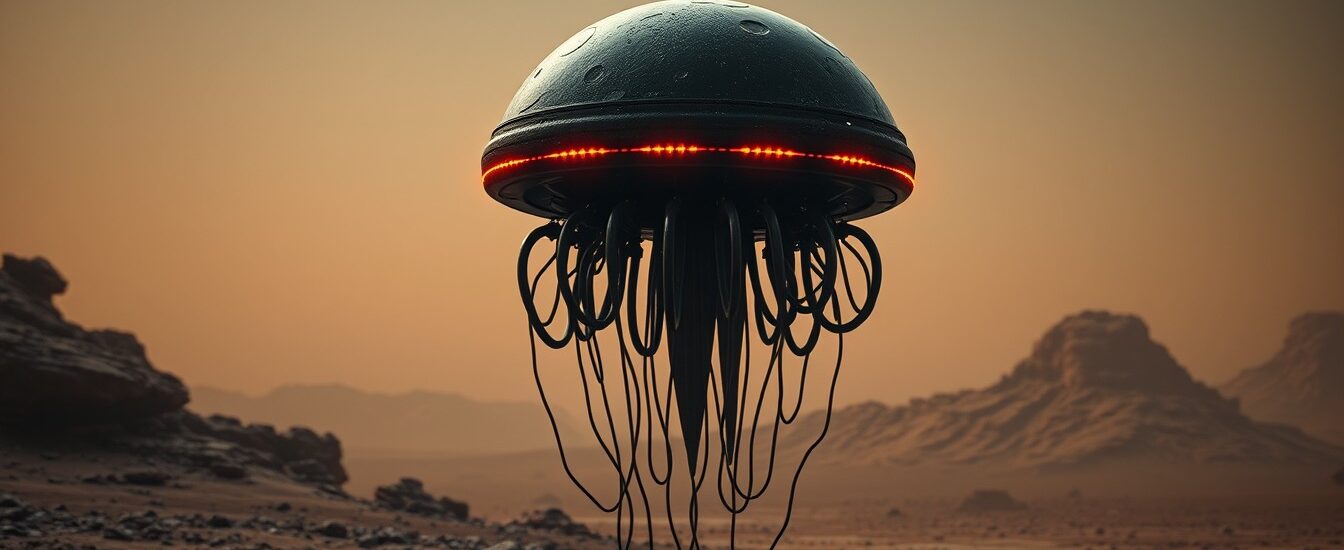
This wasn’t a blurry distant light. Captured in 2018 over an active combat zone, the sensor locked onto something bizarre: a bulbous, chandelier-like mass dragging stiff, dangling appendages behind it. It had no wings, produced zero exhaust, kicked up no rotor wash, and drifted across the crosshairs with total disregard for wind direction. To make matters weirder, the thing was actively cycling between hot and cold on the thermal feed—before allegedly dropping straight into open water without a splash and continuing on its way.
For anomaly hunters who spend their late nights digging through raw NASA archives, the silhouette sparked immediate deja vu. For years, independent researchers have spotted eerily similar organic, tentacle-like formations in raw imagery beamed back from the Curiosity rover, Perseverance, and Mars orbiters. Are we looking at camera glitches, bizarre geology, or a genuine transmedium phenomenon showing up across two different planets?
Unpacking the Jellyfish: Why This Footage Rattled Analysts
The military’s targeting pod didn’t capture a sleek, wind-tunnel-tested craft. There’s no saucer rim or pill-shaped fuselage like the famous 2004 “Tic Tac.” Instead, the Jellyfish looks disturbingly biological—less like a combat drone and more like an organism drifting through a deep-sea trench.
The visual signature breaks down into two core elements:
- A rigid central dome: A bulbous upper mass that maintained its exact shape across seventeen minutes of tracking.
- Stiff trailing “tentacles”: Multiple appendages hanging beneath the body. Crucially, they didn’t flap, swing, or whip around the way party balloons or parachute cords do in a desert breeze.
Even stranger was the thermal data. Standard aircraft show a blazing exhaust plume. Stray balloons show a uniform, passive temperature. This object cycled between dark (cool) and bright (hot) against the desert background while maintaining a fixed speed and altitude. A dirty lens or bird dropping can’t pull off that trick—it moves with the camera, not through the 3D landscape.
That mechanical steadiness combined with an organic look has led many in the disclosure movement to look past conventional aerospace explanations and revisit theories regarding the interdimensional origins of UAPs.
Not the First: Historical Sightings of “Atmospheric Beasts”
Long before leaked military FLIR videos went viral on Twitter and Reddit, pilots and researchers were logging reports of sky objects that sounded like they belonged in a vintage sci-fi comic. In the 1960s and 70s, writer John Keel gathered dozens of accounts of what he called “atmospheric beasts”—translucent, jellyfish-like entities drifting silently through the upper atmosphere.
| Era | What Witnesses Called Them | Key Behavior Logged |
|---|---|---|
| 1970s | “Atmospheric beasts,” pulsing blobs | Drifting at high altitude, contracting and expanding |
| 1980s | Floating man-of-war, umbrella craft | Hovering silently over tree lines |
| 1990s | Metallic jellyfish, tendril clusters | Hovering 200 feet over water, zero radar return |
| 2000–2017 | Semi-rigid filament craft | Tracking against heavy wind without visible engines |
One notable report from 1994 involved a commercial pilot over the Gulf of Mexico who watched an object “resembling a jellyfish made of dull metal” hovering just above the sea. His report sat buried in FAA archives for years. These weren’t the flashing glowing UFO orbs that dominate modern night-sky reports—they were distinct, structural oddities that never fit into standard military catalogs.
The Physics Problem: Moving Between Air and Water
Water is roughly 800 times denser than air. When a bird, drone, or aircraft strikes the surface at speed, physics demands a violent impact, deceleration, and displacement. Yet sensor operators tracked the 2018 object descending directly into a lake and slipping beneath the surface without so much as a ripple or a spike in thermal drag.
“A vehicle that transitions seamlessly between air and water without cavitation or thermal shock represents a materials science problem we cannot currently solve.”
— Dr. Kevin Knuth, Associate Professor of Physics and UAP Researcher
If the footage accurately depicts a solid mass entering the water, it rules out roughly 99% of conventional drone or aerostat explanations. Deflated weather balloons don’t dive cleanly into lakes, and reconnaissance decoys don’t self-regulate their internal heat signatures.
The Mars Connection: Anomaly Hunting in Raw JPL Data
While defense analysts squabble over the Iraq footage, internet researchers have been finding strangely familiar silhouettes 140 million miles away in the raw image archives of NASA’s Jet Propulsion Laboratory.
When NASA rovers beam back unedited Mastcam and Navcam frames, they hit public servers as raw, uncompressed files. Zooming into high-contrast ridgelines reveals a handful of peculiar captures:
- Curiosity Mastcam (Sol 3428): A dark ridge formation near Mount Sharp sporting a rounded “bell” head with vertical, shadow-like strands reaching down toward the red dirt.
- Perseverance Navcam (Jezero Crater): Filamentary patterns etched along hillside contours that branch off at regular 40-degree angles.
- HiRISE Orbiter (Arabia Terra): Orbital captures showing kilometer-wide basins with centralized mounds and dark, tentacle-like fractures spreading radially across the terrain.
Geologists routinely chalk these up to differential erosion, wind-sculpted basalt dikes, or transient dust devil tracks. But there’s a catch: infrared data from the THEMIS instrument on the Mars Odyssey orbiter revealed that some of these specific “appendage” formations retain heat differently than the surrounding sedimentary rock, showing anomalous thermal inertia.
Weighing the Evidence: Illusion vs. Genuine Anomaly
| Observable Detail | The Skeptical Take | The Anomalous Case |
|---|---|---|
| Trailing Appendages | Tangled balloon ribbons or sensor dust | Rigid, fixed geometry that moves independently of the gimbal |
| Thermal Shifting | Atmospheric heat shimmer / sensor drift | Localized temperature change isolated strictly to the target |
| Water Submersion | Visual illusion caused by horizon drop | Direct entry into the lake with zero kinetic splash or deceleration |
| Martian Silhouettes | Pareidolia & compressed JPEG artifacts | Multi-instrument thermal anomalies matching visible structures |
Let’s be realistic: pareidolia is real. The human brain is a hyperactive pattern-recognition machine that evolved to spot tigers in tall grass, meaning we love finding faces, doorways, and sea creatures in piles of Martian gravel. Low-resolution JPEG compression also creates blocky 8×8-pixel grid halos around rocks that can easily look like floating tendrils.
Yet, when an object on Earth shows multi-sensor tracking anomalies that match unexplainable thermal signatures on Mars, dismissing the entire catalog as “just rocks and balloons” feels like an easy way to avoid asking uncomfortable questions.
Frequently Asked Questions
What makes the 2018 Iraq Jellyfish UAP unique?
Unlike smooth discs or flying triangles, it has an organic, tentacled shape, shifted between hot and cold on thermal sensors, and exhibited apparent transmedium travel by entering water without losing speed.
Is there actual biological life or craft on Mars?
No official agency has confirmed non-geological origins for these formations. Most Martian “jellyfish” shapes are textbook examples of wind erosion, shadow play, and ancient mineral veins—though their visual overlap with recent military UAP footage continues to fuel serious debate.
Where We Go From Here
The Jellyfish UAP case exposes the biggest bottleneck in modern anomaly research: single-source data isn’t enough. We don’t need more grainy 30-second clips or pixelated screenshots of distant craters. To get real answers, researchers need unredacted, synchronized sensor fusion—optical, calibrated infrared, and radar telemetry examined under transparent, open scientific scrutiny.
Beyond the sensor telemetry and physics debates, there is an inescapable sci-fi parallel that makes the Jellyfish UAP so deeply eerie: its striking resemblance to the Imperial Viper probe droid from The Empire Strikes Back. Drifting silently with a domed upper chassis and a cluster of stiff, dangling sensor tendrils, the Iraq object glides over a conflict zone with the cold, deliberate purpose of a reconnaissance unit scanning the ice plains of Hoth. If an advanced intelligence—terrestrial or otherwise—were deploying autonomous surveillance hardware across Earth or the desolate rock fields of Mars, it wouldn’t need a polished chrome saucer. It would look and behave precisely like this.